


After an accident, one of the first questions people ask is also one of the hardest to answer:
“How much is my injury case worth?”
It is an understandable question.
You may be looking at medical bills, missed work, insurance calls, vehicle repairs, and uncertainty about what happens next. You want to know whether the claim will cover what you have already lost—and whether it accounts for what may still be ahead.
The challenge is that personal injury cases do not come with a standard price tag.
Two people can experience accidents that appear very similar but have completely different claim values.
One person may recover after a few weeks of treatment.
Another may need surgery, rehabilitation, ongoing care, or time away from work.
The difference is not just the accident itself.
It is the complete story:
- What happened?
- Who was responsible?
- How serious was the injury?
- What treatment was required?
- How did life change afterward?
- What evidence supports those losses?
- What insurance coverage exists?
A claim becomes easier to understand when those pieces come together.
Quick Answer
The value of an Atlanta personal injury case may depend on:
- The strength of the evidence showing who caused the accident
- The severity and type of injuries
- The cost of medical treatment
- Whether future medical care is expected
- Time missed from work
- Changes to earning ability
- Physical limitations
- Emotional and daily-life effects
- Available insurance coverage
- Whether fault is disputed
- The quality of supporting documentation
There is no honest calculator that can determine the value of every injury claim.
A realistic value comes from the facts of that specific person’s situation.
Key Takeaways
- Personal injury case value is built from evidence, not a simple formula.
- Serious injuries usually require a deeper review of medical care, recovery, and future effects.
- Medical bills are important, but they are only one part of the claim.
- Lost income and reduced earning ability can matter significantly.
- Georgia’s comparative-fault rules can affect recovery when more than one person contributed to an accident.
- Insurance limits may affect the practical amount available even when losses are significant.
- Early settlement offers may not reflect future medical needs or long-term consequences.
- A well-organized claim tells a complete story rather than focusing on one number.
Think of Your Claim as a Story Map
A personal injury claim is not built from one document.
It develops through several connected chapters.
| Chapter | Main Question |
| The Accident | What happened and who was responsible? |
| The Injury | What harm did the accident cause? |
| The Recovery | What treatment and limitations followed? |
| The Impact | How did daily life and work change? |
| The Evidence | Can those losses be supported? |
| The Coverage | What sources may provide compensation? |
A strong claim connects these chapters clearly.
A weak claim often has missing pieces.
For example, a person may have serious pain but limited medical documentation.
Or they may have extensive medical bills but unclear evidence showing how the accident caused those injuries.
The value discussion depends on the whole picture.
The Starting Point: How Did the Accident Happen?
Before discussing damages, a claim must usually answer a basic question:
Why is another person legally responsible?
That may involve evidence such as:
- Accident reports
- Photographs
- Video footage
- Witness statements
- Vehicle damage
- Property records
- Medical documentation
- Expert analysis when needed
Consider two crashes.
In the first, a driver runs a red light and hits another vehicle. Traffic-camera footage confirms what happened.
In the second, two drivers give completely different accounts of who entered the intersection first.
The injuries may be identical.
The claim value discussion may not be.
Why?
Because proving responsibility is part of proving the claim.
Shared Fault Can Change the Outcome
Georgia follows a modified comparative negligence approach.
Under Georgia law, an injured person may recover damages if they are not more than 50% responsible for the injury.
However, if they are found partially responsible, the amount recovered can be reduced by their percentage of fault.
That means a case involving disputed responsibility may have a different value range than a case where fault is clear.
Examples of disputed issues may include:
- Whether a driver was distracted
- Whether someone failed to yield
- Whether a person was speeding
- Whether a property owner failed to maintain safe conditions
- Whether multiple parties contributed to the accident
Fault is not just about deciding who was wrong.
It can directly affect the financial outcome.
Medical Treatment Helps Explain the Injury Story
After an accident, medical care serves two purposes.
First, it helps you recover.
Second, it creates a record of what happened after the injury.
Medical records can show:
- When symptoms began
- What injuries were diagnosed
- What treatment was recommended
- Whether symptoms improved
- Whether additional care was needed
- Whether work restrictions were necessary
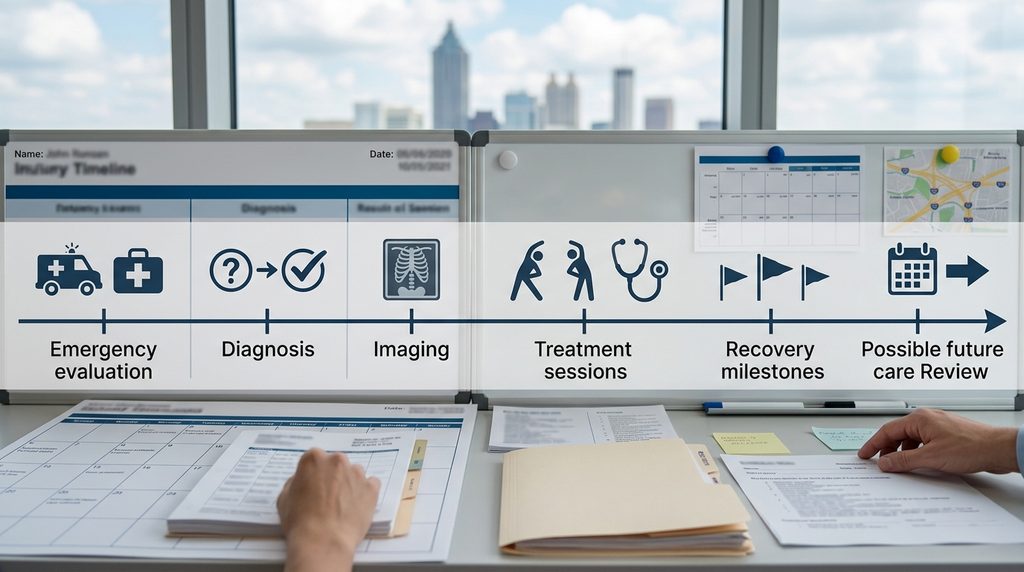
A medical file tells a timeline.
For example:
- Day 1: Emergency evaluation after crash
- Week 2: Continued pain leads to follow-up care
- Month 2: Imaging identifies additional concerns
- Month 4: Specialist recommends continued treatment
That timeline helps explain how a single accident affected someone’s life over time.
Medical Bills Are Important—but They Are Not the Whole Value
A common mistake is assuming:
“Medical bills equal case value.”
They matter.
But they are only one part of the picture.
A serious injury claim may involve:
- Emergency treatment
- Hospital expenses
- Surgery
- Physical therapy
- Medication
- Specialist visits
- Diagnostic testing
- Future medical care
But it may also involve losses that do not appear on a medical invoice.
For example:
A construction worker who cannot return to heavy lifting may face a very different financial impact than someone who misses a few days of desk work.
A parent who cannot pick up a child because of an injury experiences a different daily impact than someone whose routine remains unchanged.
The full effect matters.
Future Medical Care Can Change the Value Picture
Many people want to know the value of a case before they know how recovery will unfold.
That can be difficult.
Early after an accident, important questions may still be unanswered:
- Will therapy resolve the injury?
- Will surgery become necessary?
- Will symptoms continue?
- Will additional specialists become involved?
- Will limitations become permanent?
A settlement reached before those questions are answered may not reflect the complete picture.
The future portion of an injury claim can be one of the most important parts—especially when injuries are serious or recovery is uncertain.
Lost Income Is More Than Missing a Paycheck
Work-related losses are often misunderstood.
A person may lose income because they cannot work.
But the impact can go further.
A claim may need to consider:
- Missed shifts
- Reduced hours
- Lost overtime
- Used vacation or sick time
- Reduced earning ability
- Career changes caused by injury
Evidence may include:
- Pay statements
- Employer records
- Tax documents
- Work restrictions
- Employment history
- Business records for self-employed individuals
The strongest wage-loss claims usually connect the medical limitation to the actual financial impact.
For example:
“My shoulder injury made my job harder.”
is less specific than:
“My doctor restricted lifting, and my employer removed me from the physical duties that made up most of my position.”
Specific evidence tells a clearer story.
Some Losses Are Personal, Not Financial
Not every consequence of an injury comes with a receipt.
An accident can affect:
- Sleep
- Mobility
- Independence
- Family responsibilities
- Hobbies
- Daily routines
- Confidence
- Emotional well-being
Georgia law allows certain damages that may address the broader impact of an injury, including pain and suffering.
But these effects still need to be explained.
Specific examples are usually more meaningful than general statements.
Instead of:
“Life has been difficult.”
A clearer explanation might be:
“Before the accident, the person walked their dog every morning and coached youth sports on weekends. After the injury, those activities stopped for several months.”
The details show the difference between life before and after.
Insurance Coverage Creates Another Part of the Equation
A claim’s value and the amount available from insurance are related—but they are not always identical.
A person may have significant injuries and losses.
The available insurance coverage may still affect how much compensation can realistically be recovered.
Coverage questions may include:
- What insurance policy applies?
- What are the limits?
- Are multiple policies involved?
- Is uninsured motorist coverage available?
- Is there additional coverage?
- Are there disputes about coverage?
Georgia requires insurers to offer uninsured motorist coverage, and policyholders may choose limits depending on the policy and applicable law.
That coverage can become important when an at-fault driver has little or no insurance.

The Evidence Determines How Clearly the Story Can Be Told
Many injury claims involve the same basic question:
“Can the losses be proven?”
Strong evidence may include:
Accident Evidence
- Photos
- Videos
- Witness information
- Accident reports
- Scene documentation
Medical Evidence
- Treatment records
- Bills
- Imaging
- Physician opinions
- Follow-up records
Financial Evidence
- Pay records
- Employer documentation
- Business records
- Expense records
Personal Impact Evidence
- Daily limitations
- Recovery notes
- Activity changes
- Testimony from people who know the injured person
A claim is stronger when the evidence connects the accident to the injury and the injury to the losses.
Delayed Treatment Does Not Automatically End a Claim
People delay medical care for many reasons.
They may:
- Feel okay immediately after the accident
- Lack transportation
- Need childcare
- Worry about medical costs
- Hope pain improves naturally
- Not recognize symptoms right away
A delay does not automatically mean there is no valid injury.
But it can create questions.
An insurer may ask:
- When did symptoms begin?
- Why was treatment delayed?
- Did another event cause the symptoms?
- Was the injury related to the accident?
The best approach is honesty and documentation.
If symptoms appear later, explain when they started and what changed.
Prior Injuries Do Not Automatically Remove a Claim
Many people worry that an old injury means they cannot recover after a new accident.
That is not necessarily true.
The important question is often:
What changed after this accident?
A person may have had a previous condition but still experience:
- New symptoms
- Increased pain
- Additional treatment needs
- Reduced abilities
Medical records can help explain the difference between the previous condition and the new impact.
Atlanta’s Roads Create Many Different Injury Scenarios
Atlanta’s transportation network includes:
- I-75
- I-85
- I-285
- GA-400
- Downtown streets
- Busy intersections
- Pedestrian areas
- Commercial corridors
The same city can produce very different accident situations.
A highway collision may involve:
- High speeds
- Multiple vehicles
- Commercial traffic
A neighborhood crash may involve:
- Visibility issues
- Pedestrian activity
- Intersection conflicts
The location helps provide context.
But the value of an injury claim still depends on what happened to the individual person.

Why Quick Settlement Offers May Not Reflect Full Value
Insurance companies often try to resolve claims efficiently.
That is normal.
But an early offer may arrive before the full impact of an injury is known.
Before accepting a final settlement, people may want to understand:
- Has treatment finished?
- Is future care expected?
- Are all losses documented?
- Has work impact been measured?
- Are all insurance sources known?
- Does the settlement release future claims?
Once a settlement agreement is signed, reopening the claim may be difficult or impossible.
The timing of settlement matters.
A Simple Atlanta Injury Case Value Checklist
If you are organizing information after an accident, consider keeping:
Accident Information
- Police report
- Photos
- Videos
- Witness details
- Insurance information
Medical Information
- Hospital records
- Doctor visits
- Bills
- Imaging
- Prescriptions
- Treatment recommendations
Work Information
- Pay records
- Missed time
- Employer documentation
- Reduced duties
Recovery Information
- Daily limitations
- Activities you cannot do
- Changes from life before the accident
Insurance Information
- Policy documents
- Claim letters
- Communications
- Coverage information
The goal is not to create paperwork for its own sake.
The goal is to preserve the story of what happened.
When Does an Atlanta Injury Case Become Easier to Value?
Usually, the biggest unknowns need time to become clearer.
A claim may become easier to evaluate when:
- Fault is better established
- Medical diagnosis is clearer
- Treatment progress is known
- Future care is understood
- Work losses are documented
- Insurance coverage is identified
That does not mean every case should wait indefinitely.
It means a responsible evaluation depends on knowing the important facts.
Someone trying to understand the potential value of a serious injury claim may choose to speak with an atlanta personal injury lawyer about how these factors apply to their situation.
For broader injury claim information, personal injury lawyers can provide additional guidance about common claim issues.
Georgia Deadlines Still Matter
While injuries may take time to understand, legal deadlines continue.
Georgia generally provides a two-year limitation period for many personal injury claims under O.C.G.A. § 9-3-33, though different rules can apply depending on the type of claim and circumstances.
Some claims involving government entities may have additional notice requirements.
That means waiting until recovery is complete before learning about deadlines can create unnecessary risk.
FAQ
There is no reliable average that can predict what an individual case is worth. Injury severity, medical treatment, lost income, fault, insurance coverage, and evidence quality can all change the outcome.
Medical expenses are important, but they are only one part of the claim. A complete evaluation may also consider future medical needs, lost income, physical limitations, daily-life effects, insurance coverage, and liability evidence.
It can. Pain, physical limitations, and changes to daily life may be considered in a personal injury claim, but those effects should be supported with evidence describing how the injury changed the person’s life.
Georgia’s comparative negligence rules may reduce recovery when an injured person shares fault. The effect depends on the percentage of responsibility assigned under the circumstances.
Be careful before accepting a final settlement. An early offer may not account for future medical care, ongoing symptoms, wage losses, or other damages that are not yet clear.
Final Thoughts
There is no honest way to answer every injury case with one number.
A claim’s value comes from understanding the complete picture.
The accident itself matters.
The injury matters.
The recovery matters.
The financial impact matters.
The evidence matters.
The available insurance matters.
The strongest claims are not built around a number pulled from a formula.
They are built around a clear story showing what happened, what changed, and what the person needs moving forward.
For local directions and contact information, the Thompson Law Atlanta profile provides a local starting point.