

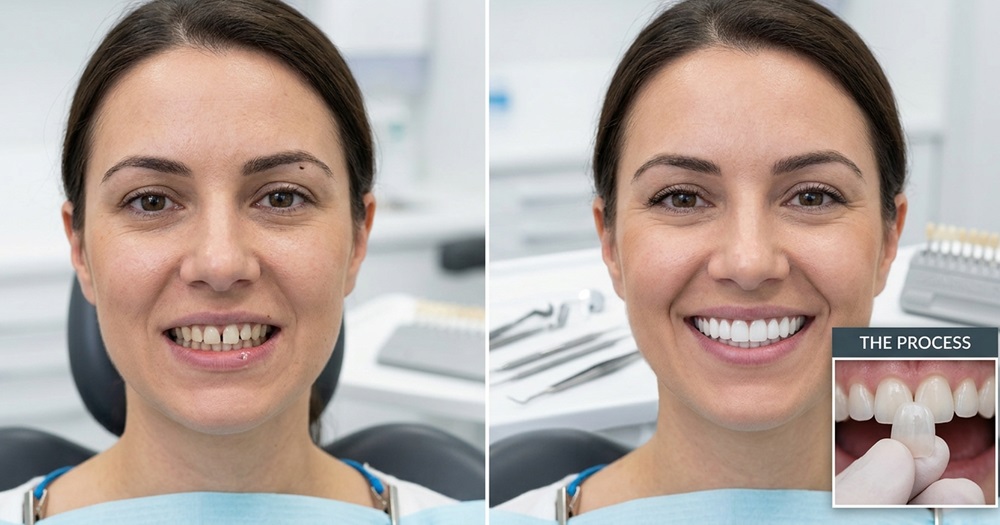
You got veneers, expecting a better smile. Instead, you got a mouth full of teeth that look like teeth-shaped Chiclets, too white, too uniform, too “done.” You’re not alone, and no, you don’t have to just live with it.
If you’re searching for a fix, here’s the good news: even if your natural teeth are already shaved down, there’s still a lot you can do to soften the look. Whether you’re getting veneers on teeth for the first time or replacing an old set, a natural result is possible with the right approach.
Why Veneers End Up Looking Fake
Before we get to fixes, it helps to know what causes that “veneer look” in the first place. It’s rarely the veneers alone.
- Shade too bright. Real teeth aren’t pure white. They have subtle variation, sometimes even a slight yellow or grey undertone near the gumline.
- Every tooth the same length and shape. Natural teeth aren’t perfectly symmetrical. A little unevenness is what reads as “real.”
- Too much opacity. Natural enamel has translucency, especially near the edges. Solid, chalky veneers lose that.
- Lip filler or cheek filler. This one surprises people. Overfilled lips can push out and frame the teeth in a way that makes the whole smile look inflated and artificial, even when the veneers themselves are decent work.
What You Can Actually Do About It
1. Get the shade adjusted or toned down
If your veneers are simply too bright, ask your dentist about subtle surface staining or choosing a shade closer to the natural color of your eyes’ sclera (the whites of your eyes). It sounds oddly specific, but it works as a reference point for what looks harmonious on your face.
2. Ask for reshaping, not just a whitening fix
A more natural set usually means:
- Slightly different lengths and shapes across the front teeth
- Softer edges instead of sharp, uniform corners
- Some texture on the surface instead of a flat, glossy finish
3. Consider a full redo, if your dentist agrees it’s needed
This is the bigger step, but if your current veneers are bulky, overly white, or just don’t sit right, a replacement set built with more natural proportions can make a real difference. This isn’t a decision to rush into. Take the time to find a dentist who shows you real before-and-after cases, not just polished stock photos, so you know what their idea of “natural” actually looks like in practice.
If you’re in the Regina area and want a second opinion, the cosmetic dentistry team at Pasqua South Dental is a solid place to start that conversation.
4. Look at what’s around your teeth, not just the teeth
Sometimes it’s not the veneers doing the damage to your smile’s natural look. Filler in the lips or cheeks can crowd the mouth and throw off the whole balance. If you’ve had filler done, ask your dentist or injector whether dissolving some of it might help before you touch the veneers again.
Before You Book Anything Else
- Don’t rush into a second procedure out of frustration. Sit with the shade and shape you don’t like for a bit and get clear on what specifically bothers you.
- Get a couple of opinions, not just one dentist’s take.
- Bring reference photos of smiles you actually like, not just “natural” as a vague word.
A more natural smile is achievable. It just usually takes a dentist who’s willing to build in a little imperfection on purpose.
FAQ
A few more questions that tend to come up once people start looking into fixing an overly done smile.
How long do veneers usually last before they need replacing?
Porcelain veneers typically last 10 to 15 years with good care, though some hold up longer. Composite veneers wear out faster, usually within 5 to 7 years.
Can veneers be made less white after they’re already placed?
Not really. Once porcelain veneers are bonded, their color is largely fixed. Minor surface staining can help a little, but a real shade change usually means replacing them.
Is it painful to have old veneers removed and replaced?
Removal itself is done under local anesthetic, so you shouldn’t feel pain during the procedure. Some sensitivity afterward is normal for a few days.
Are veneers and crowns the same thing?
No. Veneers cover just the front surface of the tooth. Crowns wrap around the entire tooth. If a lot of your natural tooth was shaved down, you may actually have crowns rather than traditional veneers, worth asking your dentist to clarify.
How much does it cost to replace a full set of veneers?
Costs vary widely by location and materials, but a full set in North America often runs anywhere from $10,000 to $30,000 or more. Getting a detailed quote from a local dentist is the only way to know your real number.