

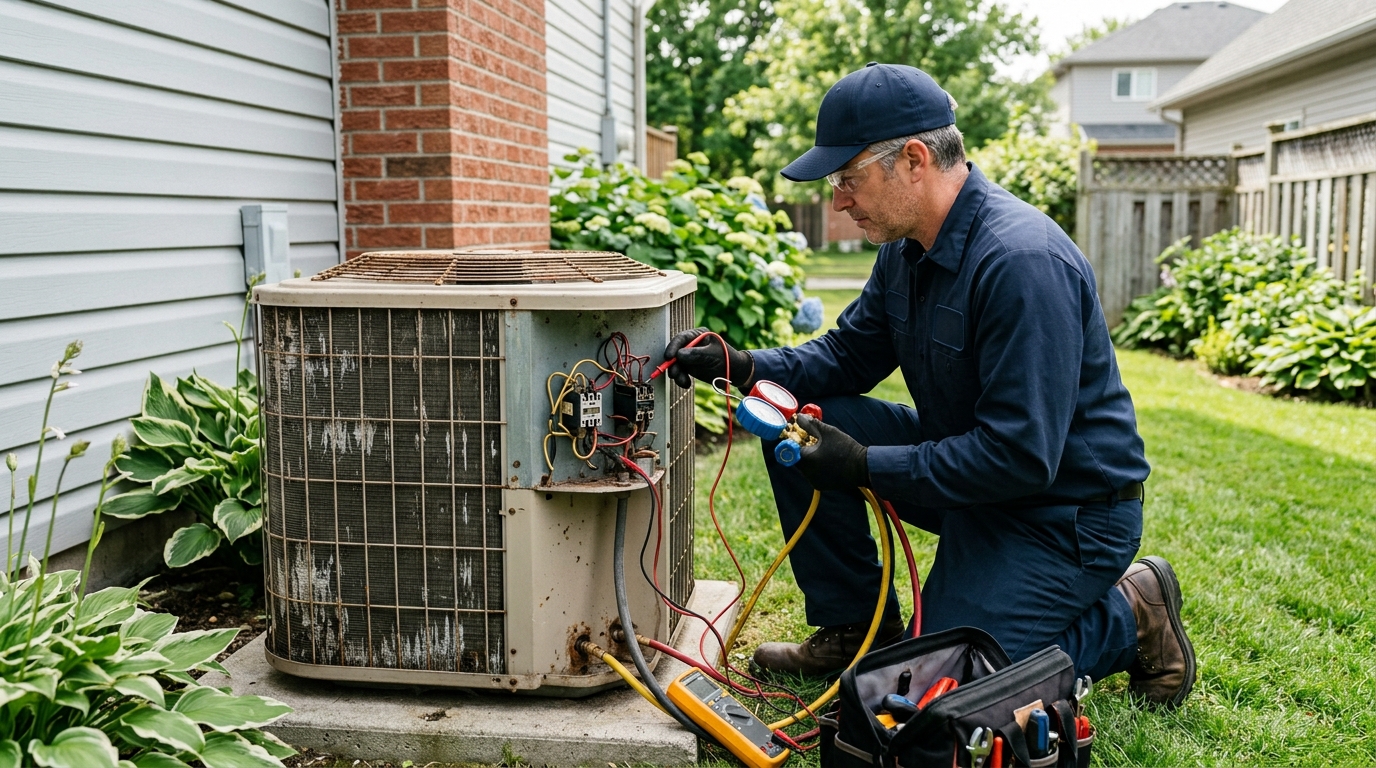
An air conditioner does not necessarily need to stop working completely before replacement becomes worth considering.
Many aging AC systems continue operating while gradually becoming less reliable, less efficient, or less effective at keeping the home comfortable. Homeowners may notice longer cooling cycles, higher electricity bills, increasingly frequent repairs, uneven temperatures, or new mechanical noises long before the equipment experiences complete failure.
The challenge is determining whether these symptoms point to a repairable problem or indicate that the cooling system is approaching the end of its practical service life.
For Michigan homeowners, recognizing the warning signs early can make replacement considerably easier to plan. Instead of making an expensive decision during a hot and humid summer breakdown, homeowners can evaluate equipment, installation requirements, efficiency options, and costs in advance.
Professional AC installation should be considered when the overall condition of an aging cooling system suggests that continued repairs may no longer provide dependable long-term value.
Quick Answer
The strongest signs that it may be time to replace an AC unit include frequent repairs, increasing electricity consumption, declining cooling performance, uneven temperatures, excessive operating noise, poor humidity control, major component failures, and older equipment experiencing several of these problems simultaneously.
One symptom does not automatically mean replacement is necessary. The overall pattern of system age, condition, efficiency, reliability, and repair history provides a better basis for the decision.
Key Takeaways
- AC age alone does not automatically justify replacement.
- Frequent repairs can indicate declining system reliability.
- Rising energy consumption may point to reduced cooling efficiency.
- Longer cooling cycles can signal deteriorating performance.
- Poor humidity control can indicate cooling or system-design problems.
- Major compressor or coil failures can significantly change replacement economics.
- Refrigerant type can matter when evaluating older equipment.
- Correct sizing and installation are critical when replacing an AC system.
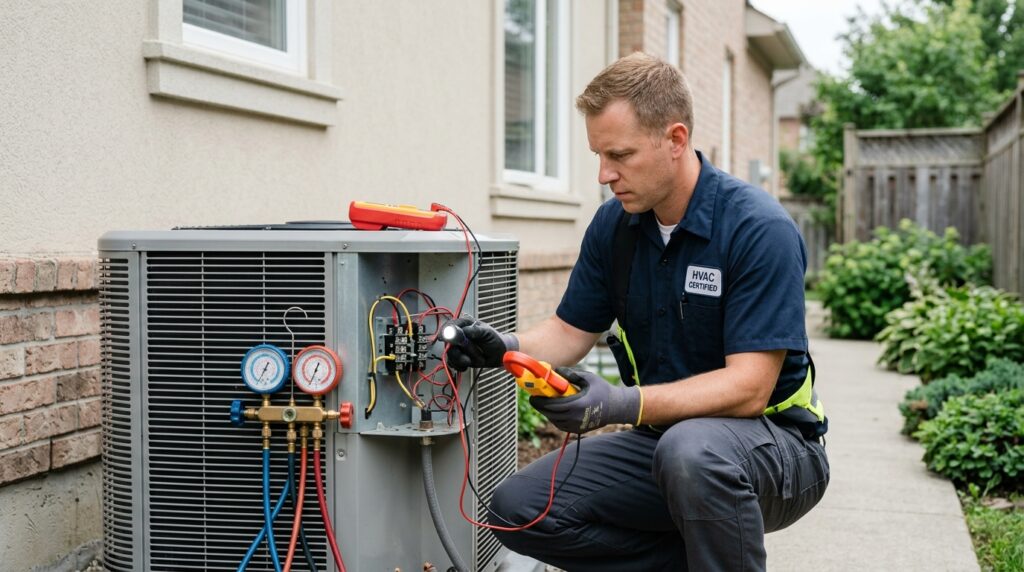
1. Your Air Conditioner Needs Frequent Repairs
An occasional repair does not mean an air conditioner needs to be replaced.
Components such as capacitors, contactors, sensors, thermostats, and fan components can fail while the rest of the cooling system remains in good condition.
The pattern becomes more concerning when service calls start occurring repeatedly.
For example, homeowners may experience:
- One electrical repair early in the summer
- A fan-related repair the following season
- A refrigerant problem later
- Another substantial repair shortly afterward
At that point, it becomes useful to calculate how much money is being invested in keeping the existing system operational.
The question changes from “Can the AC be repaired?” to “Does continuing to repair it still provide good value?”
2. Your Electricity Bills Keep Increasing
Air-conditioning costs naturally change throughout the summer.
Hotter weather increases cooling demand, while changes in electricity rates, thermostat settings, and household occupancy can also affect utility bills.
For that reason, homeowners should not assume that one expensive bill indicates AC failure.
A more useful warning sign is a sustained increase in energy consumption under reasonably similar conditions.
Possible equipment-related causes include:
- Dirty coils
- Restricted airflow
- Aging motors
- Refrigerant problems
- Mechanical deterioration
- Longer cooling cycles
- Duct leakage
The U.S. Department of Energy provides residential air-conditioning guidance covering cooling efficiency and factors that influence air-conditioning energy use.
When increasing electricity consumption occurs alongside repeated repairs or declining comfort, AC replacementdeserves closer consideration.
3. The AC Struggles to Reach the Thermostat Setting
A properly operating air conditioner should be capable of maintaining appropriate indoor conditions when it is correctly sized and operating within its design limits.
A system that previously maintained the desired temperature but now consistently struggles may have developed a problem.
Homeowners might notice:
- The AC running for unusually long periods
- Indoor temperatures remaining above the thermostat setting
- Rooms cooling very slowly
- The system operating almost continuously
- Cooling performance deteriorating during hotter weather
Potential causes include:
- Dirty coils
- Refrigerant problems
- Restricted airflow
- Compressor deterioration
- Duct leakage
- Poor insulation
- Equipment sizing problems
Because several issues can produce similar symptoms, professional diagnosis should occur before assuming replacement is necessary.
4. Some Rooms Are Consistently Warmer Than Others
Uneven cooling is another symptom that deserves investigation.
If certain rooms that were previously comfortable become consistently warmer, possible causes include:
- Duct leakage
- Airflow restrictions
- Poor system balancing
- Insulation problems
- Solar heat gain
- Equipment-performance problems
Installing a new AC system will not necessarily correct comfort problems caused primarily by ductwork or the building envelope.
A complete replacement assessment should therefore evaluate the entire cooling system rather than only the outdoor condenser.
5. The Air Conditioner Runs Almost Constantly
Long cooling cycles are not automatically abnormal during extremely hot weather.
However, a noticeable change in operating behavior can indicate that the system is struggling.
An air conditioner may run excessively because of:
- Reduced cooling capacity
- Restricted airflow
- Refrigerant problems
- Dirty heat-transfer surfaces
- Duct leakage
- Increased home heat gain
- Incorrect equipment sizing
Extended operation can also increase electricity consumption.
When an older AC begins running substantially longer while producing less effective cooling, the combination can become a meaningful replacement indicator.
6. The AC Starts Making New or Excessive Noises
Air conditioners normally make some noise during startup, operation, and shutdown.
Homeowners should pay attention when familiar operating sounds change significantly.
Potential warning sounds include:
- Grinding
- Screeching
- Buzzing
- Rattling
- Banging
- Persistent clicking
These noises may originate from repairable problems involving fans, motors, electrical components, loose parts, or other mechanical components.
Noise alone does not automatically justify replacement.
It becomes more relevant when accompanied by advanced equipment age, repeated repairs, declining cooling performance, or a major component problem.
7. Indoor Humidity Becomes Harder to Control
Air conditioners do more than lower indoor temperature. During normal cooling operation, they also remove moisture from indoor air.
If a home begins feeling noticeably more humid during cooling season, possible causes include:
- Reduced AC performance
- Incorrect equipment sizing
- Airflow problems
- Short cycling
- Duct leakage
- Building-envelope issues
Poor humidity control should therefore be investigated rather than automatically attributed to equipment age.
If the existing system is oversized, simply replacing it with another unit of identical capacity may reproduce the same problem.
This is one reason proper system sizing is important when planning replacement.
8. The System Starts Short Cycling
Short cycling occurs when the air conditioner starts and stops repeatedly without completing normal cooling cycles.
Possible causes can include:
- Thermostat problems
- Electrical issues
- Refrigerant problems
- Restricted airflow
- Equipment sizing problems
- Control faults
Repeated short cycling can increase equipment wear and reduce comfort.
A repairable control problem may be responsible, particularly on otherwise healthy equipment.
However, persistent cycling problems on an older AC system with several additional warning signs deserve a broader evaluation.
9. A Major Component Fails
Not all air-conditioning repairs have the same financial significance.
Replacing an inexpensive electrical component is very different from dealing with a major compressor or coil problem.
When an expensive component fails, homeowners should evaluate:
- AC age
- Repair estimate
- Warranty coverage
- Refrigerant type
- Condition of other components
- Previous repair history
- Existing efficiency
- Expected remaining life
For newer equipment with warranty coverage, repair may remain the logical option.
For older equipment already experiencing multiple problems, a major failure can shift the financial case toward replacement.
10. The Existing System Uses an Older Refrigerant
Refrigerant type can become important when aging cooling equipment develops leaks or other refrigerant-related problems.
Older residential systems may use R-22. Production and import of virgin R-22 in the United States ended in 2020, although existing equipment can still be serviced with reclaimed or previously produced supplies.
Homeowners can review the EPA’s information about R-22 and older air-conditioning equipment.
An R-22 system does not automatically need replacement.
However, equipment age, refrigerant availability, repair cost, and overall system condition should all be considered when a substantial refrigerant-related repair becomes necessary.
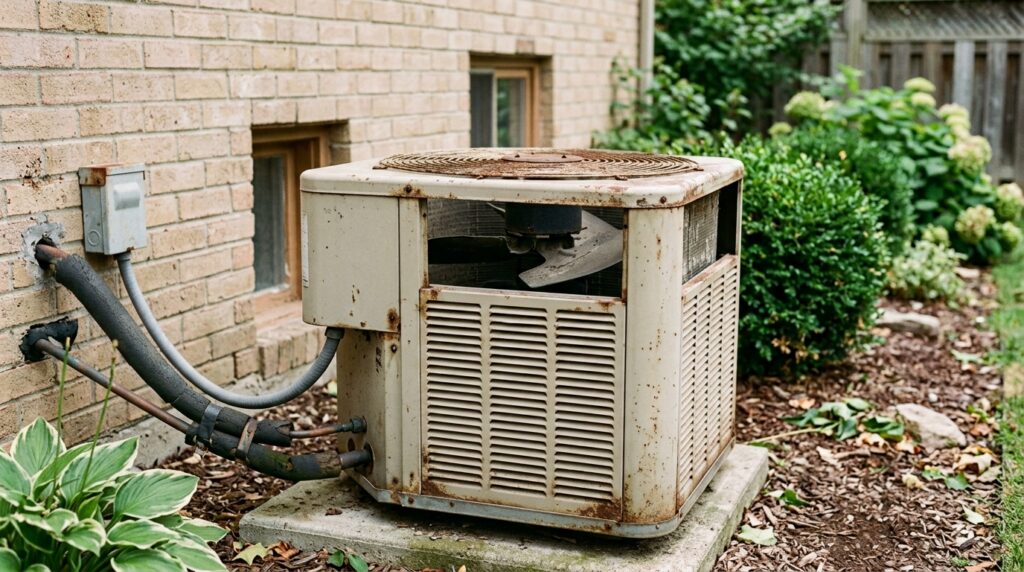
11. The Air Conditioner Is Older and Showing Other Warning Signs
Age becomes most useful when it is considered alongside actual equipment performance.
ENERGY STAR recommends considering replacement when an air conditioner or heat pump is more than 10 years old, particularly when frequent repairs, rising energy costs, or comfort problems are also present.
Homeowners can review ENERGY STAR heating and cooling replacement guidance for additional considerations.
This should not be interpreted as an automatic ten-year replacement rule.
Instead, an older AC deserves closer evaluation when it also:
- Breaks down repeatedly
- Runs substantially longer
- Struggles to maintain comfort
- Produces excessive noise
- Requires major repairs
- Uses increasing amounts of electricity
The combination of symptoms provides more useful information than age alone.
12. Repair Costs Are Becoming Difficult to Justify
An aging air conditioner can eventually reach a point where continued repair becomes economically questionable.
Imagine a system that needs another substantial repair after homeowners have already paid for multiple service calls during recent summers.
Before authorizing the work, they should ask:
- How much has already been spent?
- What condition are the other components in?
- Is another major repair likely?
- How efficient is the system?
- Is the equipment still dependable?
- How long is the repaired AC expected to remain useful?
The goal is not to avoid repairing older equipment automatically.
It is to avoid repeatedly investing in a system whose reliability and performance continue declining.
Replacement Should Address the Cause of Existing Problems
If replacement becomes necessary, homeowners should avoid assuming that equipment alone caused every comfort problem.
A comprehensive evaluation should consider:
- Cooling load
- Ductwork
- Airflow
- Insulation
- Air leakage
- Thermostat location
- Electrical requirements
- Condensate drainage
Professional HVAC installation service should account for these factors so the replacement system is matched appropriately to the home.
Why Proper AC Sizing Is Critical
Bigger is not necessarily better when selecting an air conditioner.
Oversized equipment may satisfy the thermostat quickly but operate in shorter cycles, potentially reducing humidity-control performance and creating less consistent comfort.
Undersized equipment may operate for very long periods during hot weather and still struggle to maintain the desired temperature.
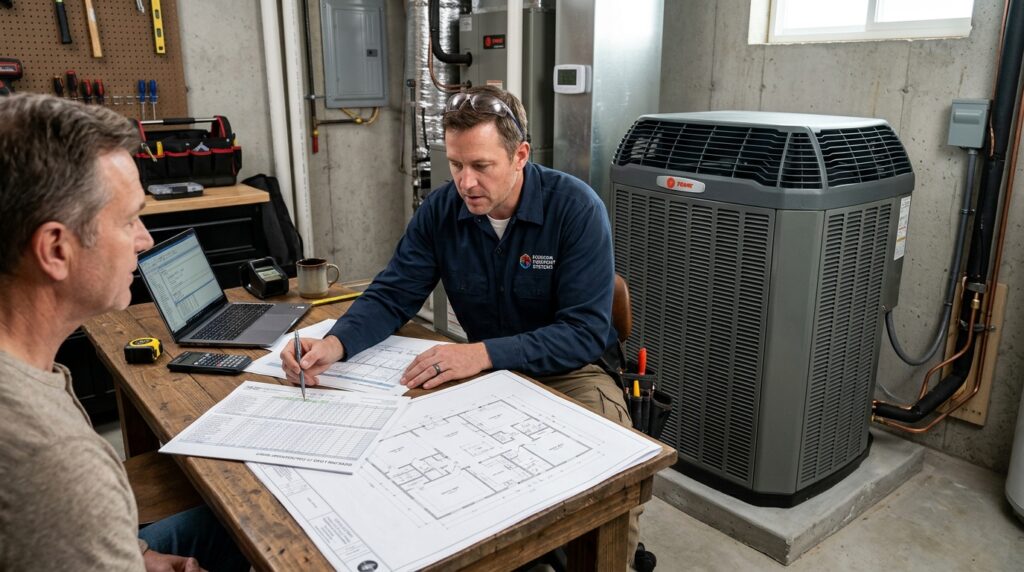
Proper sizing should consider the home’s actual cooling load rather than relying only on square footage or the capacity of the previous AC.
ENERGY STAR’s HVAC quality installation guidance emphasizes correct equipment sizing as an important part of HVAC installation.
What Can Homeowners Expect From AC Replacement?
Replacing an aging air conditioner can improve more than basic cooling, particularly when the existing system has lost efficiency or no longer maintains consistent indoor conditions.
Depending on the equipment and installation, potential improvements may include:
- More consistent temperatures
- Improved energy efficiency
- Better humidity management
- Quieter operation
- Improved airflow
- More precise temperature control
- New equipment warranty coverage
- Compatibility with modern controls
These improvements are not guaranteed simply because the equipment is new.
The quality of the AC installation and the suitability of the selected equipment have a major influence on actual performance.
Understanding SEER2 When Comparing New AC Systems
Homeowners shopping for replacement air conditioners will encounter SEER2, or Seasonal Energy Efficiency Ratio 2.
SEER2 provides a standardized way to compare seasonal cooling efficiency. Generally, a higher SEER2 rating indicates greater cooling efficiency under standardized testing conditions.
However, efficiency ratings should not be treated as the only factor when choosing equipment.
A homeowner should also consider:
- Initial equipment cost
- Local electricity rates
- Annual cooling demand
- Expected ownership period
- Installation quality
- Ductwork condition
- Home insulation and air leakage
The highest-efficiency system available is not automatically the most economical option for every Michigan home.
The goal should be to select equipment that provides an appropriate balance of efficiency, comfort, reliability, and ownership cost.
Will a Higher-Efficiency AC Always Save Enough to Justify the Cost?
Not necessarily.
Higher-efficiency equipment can reduce electricity consumption compared with less-efficient equipment operating under comparable conditions. But the financial payback depends on how much cooling the home actually requires.
Michigan homeowners generally have a shorter cooling season than homeowners in many southern climates. That can affect the amount of annual savings available from higher-efficiency equipment.
A useful comparison should consider:
Upfront difference in price + estimated operating cost + expected years of ownership.
Homeowners should be cautious of claims promising a specific percentage of savings without considering the home, existing equipment, electricity rates, and usage patterns.
Ductwork Should Be Evaluated Before Installing a New AC
A new air conditioner cannot overcome every problem in the air-distribution system.
Leaking or poorly designed ductwork may contribute to:
- Uneven room temperatures
- Weak airflow
- Longer cooling cycles
- Reduced comfort
- Increased energy consumption
If these problems existed with the old equipment, they may continue after replacement unless the duct system is addressed.
Before an AC replacement, homeowners should ask whether the contractor has evaluated both supply and return airflow.
Potential duct improvements may include:
- Sealing leakage
- Correcting damaged sections
- Improving return airflow
- Removing restrictions
- Addressing improper duct sizing
- Improving system balancing
This broader approach can help ensure that new equipment performs as intended.
Don’t Automatically Replace the Old AC With the Same Size
Replacing an old three-ton air conditioner with another three-ton unit may seem logical.
But the existing equipment may never have been correctly sized.
The home’s cooling requirements may also have changed because of improvements such as:
- New windows
- Added insulation
- Air sealing
- Home additions
- Layout changes
Professional HVAC installation service should therefore include an evaluation of current cooling requirements.
Correct sizing helps the system maintain temperature and humidity without unnecessary cycling.
Warranty Coverage Deserves Careful Comparison
New air-conditioning equipment typically comes with manufacturer warranty coverage, but the terms can vary considerably.
Before selecting equipment, homeowners should understand:
- Parts warranty duration
- Compressor coverage
- Registration requirements
- Labor coverage
- Maintenance requirements
- Transferability provisions
A long advertised warranty does not necessarily mean every repair cost will be covered.
For example, a manufacturer may cover a replacement component while labor or diagnostic costs remain the homeowner’s responsibility.
Homeowners should therefore request written warranty details before selecting equipment.
Repair vs. Replacement: Three Common Situations
Scenario 1: A Relatively Young AC Needs a Minor Repair
Consider an air conditioner that has operated reliably for several years but suddenly develops a capacitor or electrical-control problem.
If the repair is reasonably priced and the remaining equipment is in good condition, repair will generally deserve serious consideration.
There may be little financial justification for replacing an otherwise healthy system because of one serviceable component.
Scenario 2: An Older AC Has Needed Several Recent Repairs
Now consider an aging air conditioner that has already needed several service calls.
The homeowner may also notice:
- Higher summer electricity bills
- Longer operating cycles
- Increasing noise
- Uneven cooling
- Reduced humidity control
Another repair should be evaluated in the context of this larger pattern.
The system may still be repairable, but continued repairs may no longer provide the best long-term value.
Scenario 3: An Older AC Develops a Major Component Problem
A major compressor or coil problem creates a different financial decision.
Before authorizing an expensive repair, homeowners should determine:
- Whether the component is under warranty
- The system’s age
- Refrigerant type
- Condition of other major components
- Recent repair history
- Expected remaining service life
For aging equipment already showing several replacement signs, a major failure can make replacement considerably more attractive.
Consider How Long You Plan to Stay in the Home
Expected ownership period can influence replacement economics.
A homeowner planning to remain in the property for many years may place greater value on:
- Higher efficiency
- New warranty coverage
- Improved comfort
- Reduced repair uncertainty
- Quieter operation
Someone expecting to move relatively soon may evaluate those benefits differently.
However, ownership plans should not override equipment condition.
An unreliable air conditioner that requires repeated repairs can still create unnecessary expense regardless of how long the homeowner intends to remain in the property.
Don’t Wait for Complete Failure to Start Planning
Homeowners do not necessarily need to replace an aging AC while it is still operating normally.
However, there is a difference between replacing equipment prematurely and planning for predictable replacement.
If an older system has already developed several warning signs, homeowners can begin researching:
- Equipment options
- Efficiency levels
- Installation requirements
- Warranty coverage
- Contractor qualifications
- Budget considerations
This preparation becomes particularly useful before Michigan’s warmer months.
A planned replacement gives homeowners considerably more time to compare options than an emergency failure during a period of high summer temperatures.
Spring Is a Good Time to Evaluate an Aging AC
Because air conditioners may remain unused for much of a Michigan winter, homeowners may not discover problems until cooling season begins.
Testing and evaluating the system before peak summer demand provides time to identify issues involving:
- Startup
- Cooling performance
- Outdoor equipment
- Airflow
- Drainage
- Thermostat response
- Unusual operating noise
If a significant problem is discovered, homeowners then have time to compare repair and replacement options before cooling becomes urgently necessary.
What Should an AC Replacement Proposal Include?
A replacement proposal should provide more information than the model number and final price.
Homeowners should expect enough detail to understand what is actually being installed.
A comprehensive proposal may address:
- Equipment make and model
- Cooling capacity
- SEER2 efficiency
- Installation scope
- Refrigerant-line requirements
- Electrical requirements
- Drainage
- Thermostat
- Duct modifications
- Warranty coverage
- Permit requirements where applicable
- Removal of existing equipment
The exact project requirements will vary by home.
Comparing proposals based on scope rather than price alone helps homeowners understand why two quotes for apparently similar equipment may differ.
Questions to Ask an AC Installation Contractor
Before approving replacement, homeowners may want to ask:
- How was the recommended AC size determined?
- Was a cooling-load calculation performed?
- What SEER2 rating is being proposed?
- Does the ductwork need modification?
- Will existing refrigerant lines be reused or replaced?
- What refrigerant does the new equipment use?
- What warranties are included?
- Is labor covered separately?
- How will airflow be verified?
- How will the system be tested after installation?
A professional contractor should be able to explain why the recommended equipment and installation approach are appropriate for the home.
Choosing an AC Installation Provider
Contractor selection can be just as important as equipment selection.
When comparing providers, homeowners may want to consider:
- Appropriate licensing and insurance
- Residential cooling experience
- Load-calculation practices
- Installation procedures
- Written proposals
- Warranty support
- Maintenance capabilities
- Communication and responsiveness
Customer feedback can provide additional context. Reviewing public business profiles can help homeowners evaluate reported service experiences alongside technical qualifications and written installation proposals.
Reviews should be one part of the contractor-selection process rather than the only factor.
Avoid Choosing Replacement Equipment Based Only on Price
The lowest installation quote does not necessarily provide the lowest long-term cost.
A less comprehensive proposal may exclude work involving:
- Duct modifications
- Electrical upgrades
- Drainage improvements
- Thermostat replacement
- Refrigerant-line work
- System commissioning
Likewise, the most expensive proposal is not automatically the best.
Homeowners should compare equipment, installation scope, warranty coverage, contractor qualifications, and expected performance rather than simply ranking estimates from lowest to highest.
Replacement Should Solve the Existing Problem
Before installation begins, homeowners should understand why the existing AC is not performing properly.
If the old system struggled because of incorrect sizing, inadequate return airflow, duct leakage, or another design problem, simply installing new equipment without correcting the underlying issue may reproduce similar comfort problems.
The replacement process should therefore answer two questions:
What is wrong with the existing system?
and
How will the proposed installation correct it?
That distinction can make the difference between simply owning newer equipment and actually improving home comfort.
Conclusion
An air conditioner rarely needs replacement because of one isolated symptom.
The strongest case develops when several warning signs occur together: frequent repairs, rising electricity consumption, poor cooling, excessive runtime, uneven temperatures, humidity problems, unusual noise, major component failures, and advanced equipment age.
Even then, professional diagnosis is important because ductwork, airflow, insulation, thermostat problems, or other home conditions can sometimes imitate equipment failure.
When replacement is appropriate, homeowners should look beyond the outdoor AC unit itself.
Proper sizing, efficiency selection, ductwork evaluation, installation quality, warranty coverage, and system commissioning all influence how well the new equipment performs.
For Michigan homeowners, identifying these warning signs before complete failure provides another important advantage: time.
Instead of choosing equipment during an emergency summer breakdown, homeowners can compare systems, understand installation proposals, evaluate contractors, and make a planned decision based on long-term comfort, reliability, efficiency, and value.
Frequently Asked Questions
What are the clearest signs that I may need a new AC unit?
The strongest warning signs include frequent repairs, rising electricity bills, long cooling cycles, uneven room temperatures, poor humidity control, unusual noises, major component failures, and an older system showing several of these symptoms together.
How old is too old for an air conditioner?
There is no single age at which every AC system must be replaced. ENERGY STAR suggests considering replacement when an air conditioner or heat pump is more than 10 years old, especially when frequent repairs, rising energy costs, or comfort problems are also present.
Should I replace my AC if it still cools the house?
Not necessarily. A system that still cools effectively, operates reliably, and does not require frequent repairs may still have useful life remaining. Replacement becomes more compelling when performance, reliability, and efficiency all decline.
Can high electricity bills mean my AC is failing?
Yes. A sustained increase in electricity consumption can indicate declining cooling efficiency, particularly when weather, thermostat settings, and household routines have remained relatively consistent.
Is poor humidity control a sign that AC replacement is needed?
It can be. Poor humidity control may indicate AC performance problems, incorrect system sizing, short cycling, duct leakage, or airflow issues. The cause should be diagnosed before replacement is assumed to be necessary.
Can frequent AC repairs mean the system is near the end of its life?
Yes. One repair is not necessarily concerning, but repeated service calls over a short period can indicate declining reliability. When repair costs continue rising, AC replacement may deserve serious consideration.
Is a major compressor failure always a reason to replace the AC?
Not always. A newer system with warranty coverage may still be worth repairing. For an older system with multiple other problems, a compressor failure can significantly strengthen the case for replacement.
Why does proper AC sizing matter?
Professional AC installation should be based on the home’s actual cooling load. Oversized equipment can short cycle and reduce humidity control, while undersized equipment may run excessively and still struggle to maintain temperature.
Can ductwork problems make an AC seem like it is failing?
Yes. Duct leakage, restricted airflow, poor return-air design, and improper balancing can all create uneven temperatures and long cooling cycles. A new AC system will not automatically correct those problems.
Does refrigerant type matter when replacing an older AC?
Yes. Older systems that use phased-out refrigerants such as R-22 can become more expensive or difficult to service. Refrigerant type becomes especially important when a major leak or coil problem develops.
Should I replace my AC before it completely stops working?
Not always. However, if an older system is showing several replacement signs, planning ahead can provide more time to compare equipment, warranties, efficiency levels, and installation proposals.
What should I compare before choosing a new AC system?
Important factors include:
- Cooling capacity
- SEER2 efficiency
- Equipment warranty
- Installation scope
- Ductwork condition
- Refrigerant type
- Thermostat compatibility
- Contractor qualifications
- Long-term operating cost
A professional HVAC installation service should address both equipment selection and system design.